
Food waste
About your food waste collections
Collections have now been rolled out across the District and you should be receiving weekly food waste collections. Your refuse and recycling collections will continue as usual every other week: food waste collections are an additional service.
Food waste bins will be collected weekly on the same day as either your recycling or general waste bin. Bins should be placed out for collection by 6am.
You can receive alerts for collection days by downloading the free Council app. Simply search for “Horsham District Council” in the Apple App Store or Google Play Store to access it.
Alternatively, visit our Bin Calendar webpage and use the postcode search to view the collection dates for your property.
How the food waste is recycled
Once collected in the specially designed smaller collection vehicles, food waste from homes across Horsham District will be transported, in bulk, to the Horsham Anaerobic Digestion Plant, operated on behalf of West Sussex County Council.
At the plant, the waste will undergo anaerobic digestion, a process that converts waste into biofertiliser and renewable energy. The biofertiliser will be supplied to local farmers for use on their fields, while the energy generated will power the plant itself, with any surplus energy exported to the national grid to provide power for homes.
Watch our short video on what happens to your food waste after collection.
What you can put in your food waste caddy
Please remove all packaging and plastic from food waste before putting it into your food waste bin.
You can put cooked and uncooked food waste into your food waste caddy, including:
- meat - including bones
- fish and shellfish
- dairy products such as cheese and yoghurt
- cooked and uncooked vegetables and fruit including peelings
- bread, cakes and pastries
- rice, pasta and beans
- plate scrapings
- tea bags and coffee grounds
- eggshells
- solid fats
- pet food
- mouldy and out-of-date food
What you can't put in your food waste caddy
Do not put the following in your food waste bin:
- non-food products or materials, such as cutlery or takeaway boxes
- packaging of any sort, such as packaged ready-meals and plastic carrier bags (unless you are using them to line your kitchen caddy)
- oils and liquids
- animal waste and bedding
- flowers
If you put items that can’t be accepted into your food waste bin, it will not be emptied.
Your food waste is being collected every week, so it shouldn’t smell. Moving the contents of the kitchen caddy to the external bin regularly will also reduce the possibility of smells. In addition, if you want to wrap odorous items like fish in newspaper, that can help prevent odours.
The kitchen caddies and external bins are small enough to be easily cleaned with hot water and washing up liquid if needed and keeping your food waste bin lid closed will also help to contain any potential smells.
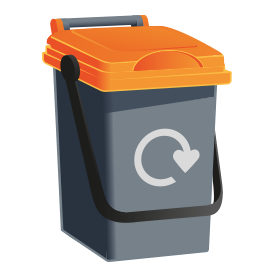
Your outdoor grey and orange food waste bin is sealable and lockable to prevent pests and vermin from opening it or the contents spilling out if it is knocked over.
Many other food waste collection schemes across England operate successfully without vermin issues. These proven systems demonstrate that with proper use and management of lockable food waste bins, the risk of attracting pests can be controlled effectively.
The new food waste collection forms part of your overall collection policy, which is carried out by us as your local District Council. This forms part of our statutory duties, which are covered by your usual Council Tax payments.
Central Government has provided us with extra funding to cover the costs of setting up the service, which includes funding for the purchase of trucks, staffing costs, and other costs such as communications work.
We strongly recommend that you make use of the food waste service offered, as this will help reduce the amount of general waste you produce and promote the recycling of food materials. By separating your food waste, you can also become more aware of the quantity of food being discarded and this can help reduce it and cut down on household bills.
Please be advised that under Section 46 of the Environmental Protection Act 1990, appropriate arrangements for food waste collection must be provided to facilitate proper waste management.
That is great news, as our key priority is to reduce the amount of wasted food produced in the first place, but there is often unavoidable food waste - such as tea bags, banana peels, plate scrapings, chicken carcass and bones - which currently is not being recycled and bones cannot be put in a home composter.
Composting at home is a great way to recycle your food waste but not all food waste can be disposed of in this way. If you compost at home you can use the food recycling bin provided to you for meat bones, cooked food, and dairy products, all of which isn’t recommended for composting at home.
No matter how little food you waste, it’s really important that it is recycled. Your food recycling bin will always be emptied no matter how little it contains.
The garden waste collected is composted outside. Some food waste can’t be treated in the same way - it must be treated using heat to make it safe - so you cannot put any food waste into your garden waste bin.
You can put tea bags into your food waste collections because the plastic used to seal the bags is very small and does not impact on the large-scale composting process.
Please don't put any packaging into the food waste bin: most food packaging can be recycled at home. For more recycling information visit our Recycling page.
Most supermarkets stock compostable liners to use in your internal kitchen caddy and are usually displayed alongside other types of bin liners. We recommend using 7 litre liners to provide enough space for overhang.
If you choose not to use liners once these run out, your food waste can be placed in your kitchen caddy loose, but it could help to keep it clean if you use a sheet of kitchen roll or piece of newspaper, which can help soak up any liquids.
While you can use plastic bags to line your kitchen caddy we do not recommend this but instead recommend reusing bags such as your old bread bags rather than buying new plastic bags please. Whilst the majority of the bags used to line caddies will be removed during the anaerobic digestion process, it is not possible to remove 100% of the material. Buying new plastic liners also increases the amount of single use plastics and microplastics entering the waste stream.
While you can use plastic bags to line your kitchen caddy, we do not recommend this. Buying plastic caddy liners increases the amount of single use plastics, so if you do choose not to buy compostable liners we suggest reusing existing bags such as bread bags.
Tips to reduce your food waste
Lots of food waste can be easily avoided, saving you money and helping you to protect the environment. There are a few simple things your family can do to reduce food waste.
- Shop smart by planning meals, making a shopping list and buying seasonal produce
- Batch cook and freeze the rest.
- Before throwing food out, consider whether it can be frozen to be used another day
- Think about how any leftovers can be used to form the basis of another meal, such as soups, sauces or sandwiches
- Compost any peelings and eggshells.